
When Do You Need a Lease Plan? A Guide for Leaseholders, Landlords and Agents
Selling a flat, extending a lease or splitting a property? Here are the situations where the Land Registry will expect a compliant lease plan — and what happens if yours doesn't meet the standard.
Key Takeaways
- Lease plans are legal documents; ordinary marketing floor plans are not acceptable substitutes.
- New leases, lease extensions, deeds of variation and title splits all typically require a compliant plan.
- Commercial leases granted for more than seven years must be registered with a compliant plan.
- The Land Registry rejects plans that lack scale, orientation or clear identification of the demised areas.
- A rejected plan delays conveyancing — commissioning a compliant plan early keeps transactions on track.
Most people never think about lease plans until a solicitor asks for one — usually mid-transaction, when time is already tight. Yet a missing or non-compliant plan is one of the most common reasons leasehold transactions stall at the Land Registry.
This guide covers the situations where a lease plan is genuinely required, what the Land Registry expects, and how to avoid the rejection letters that delay completions. For a full introduction to what these documents are, see our guide to what a lease plan is.
What a Lease Plan Actually Does
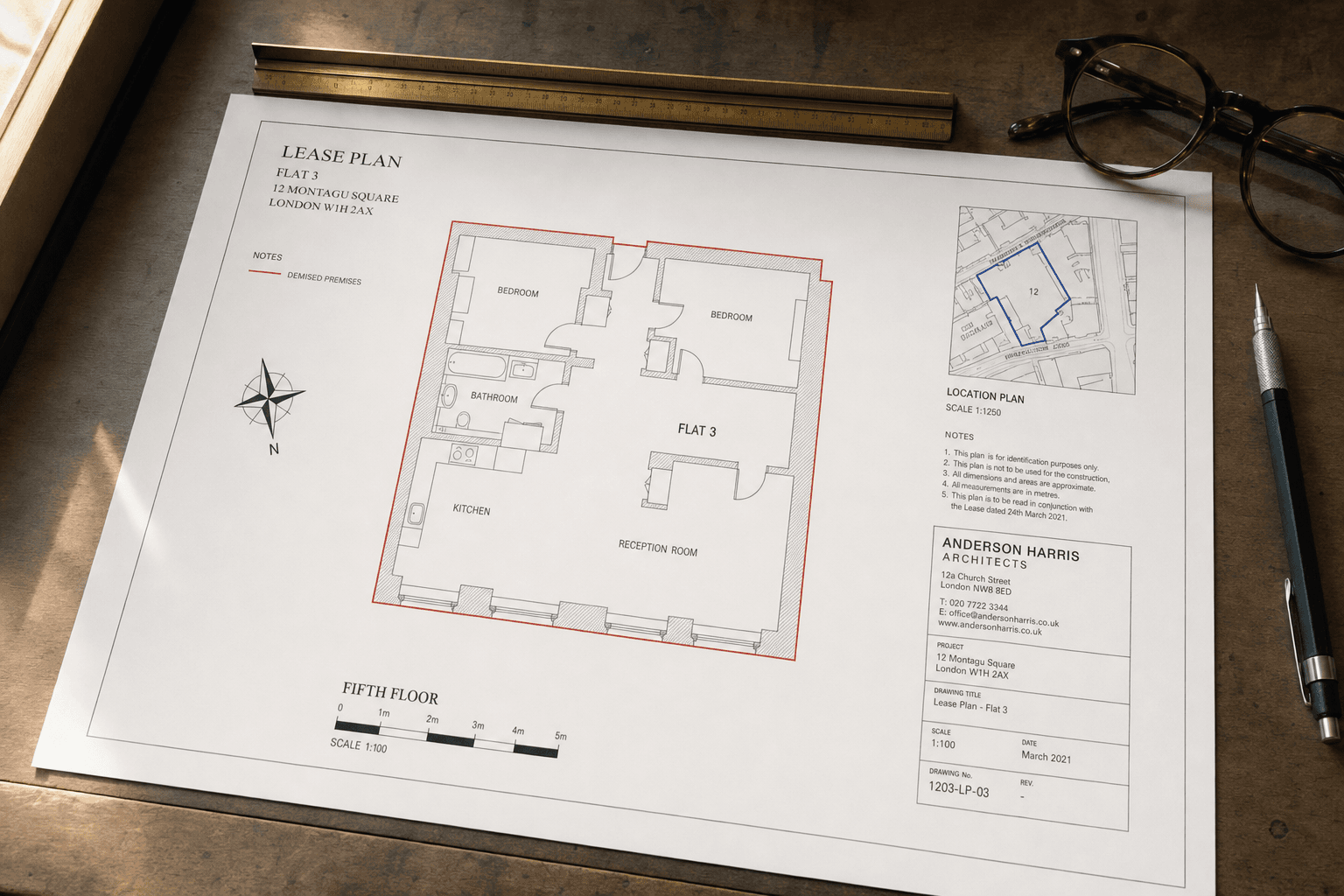
A lease plan is a legal drawing that defines the demised premises — the exact extent of the property included in a lease. It shows what the leaseholder is buying, what remains with the freeholder, and where the boundaries between the two sit.
That legal purpose is why a lease plan is held to a much higher standard than the floor plans used in estate agency marketing. A marketing plan helps a buyer understand a layout. A lease plan determines who owns what, potentially for a century or more.
Situation 1: Granting a New Lease on a Flat
The most common trigger. When a flat is sold on a new long lease — a new-build apartment, a converted house split into flats, or a freeholder granting a first lease — the lease must be registered, and registration requires a compliant plan identifying the demise.
Developers converting a single house into flats will need a plan for each unit, plus clarity on shared areas such as hallways, gardens, bin stores and parking.
Situation 2: Lease Extensions
Extending a lease usually involves surrendering the old lease and granting a new one. If the existing title plan is accurate and the extent is unchanged, the old plan can often be reused — but the Land Registry frequently finds older plans (particularly pre-1990s deeds) fall short of current standards.
If the original plan is poor quality, hand-drawn, missing a scale or ambiguous about the demise, expect to need a new one. Commissioning it early avoids a last-minute scramble between exchange and completion.
Situation 3: Splitting a Title
Whenever part of a registered property is sold or leased separately — a garden plot sold to a neighbour, a shop let separately from the flat above, a house divided into two — the new lease or transfer of part needs a plan showing precisely which land is affected.
These are the plans the Land Registry scrutinises most closely, because an ambiguous split creates boundary problems that surface years later.
Situation 4: Commercial Leases Over Seven Years
Commercial leases granted for a term of more than seven years must be registered at the Land Registry, and leases of part (a floor of an office building, a unit in a parade) require a compliant plan of the demise.
Even for shorter leases, many landlords and tenants commission plans anyway — they prevent disputes about repairing obligations, service charge apportionment and rights over common parts.
Situation 5: Deeds of Variation and Corrections
If a lease is varied in a way that changes the extent — adding a parking space, incorporating a loft, adding a garden area — the variation needs a plan showing the revised demise. The same applies when correcting a defective plan discovered during a sale.
What Makes a Plan "Compliant"
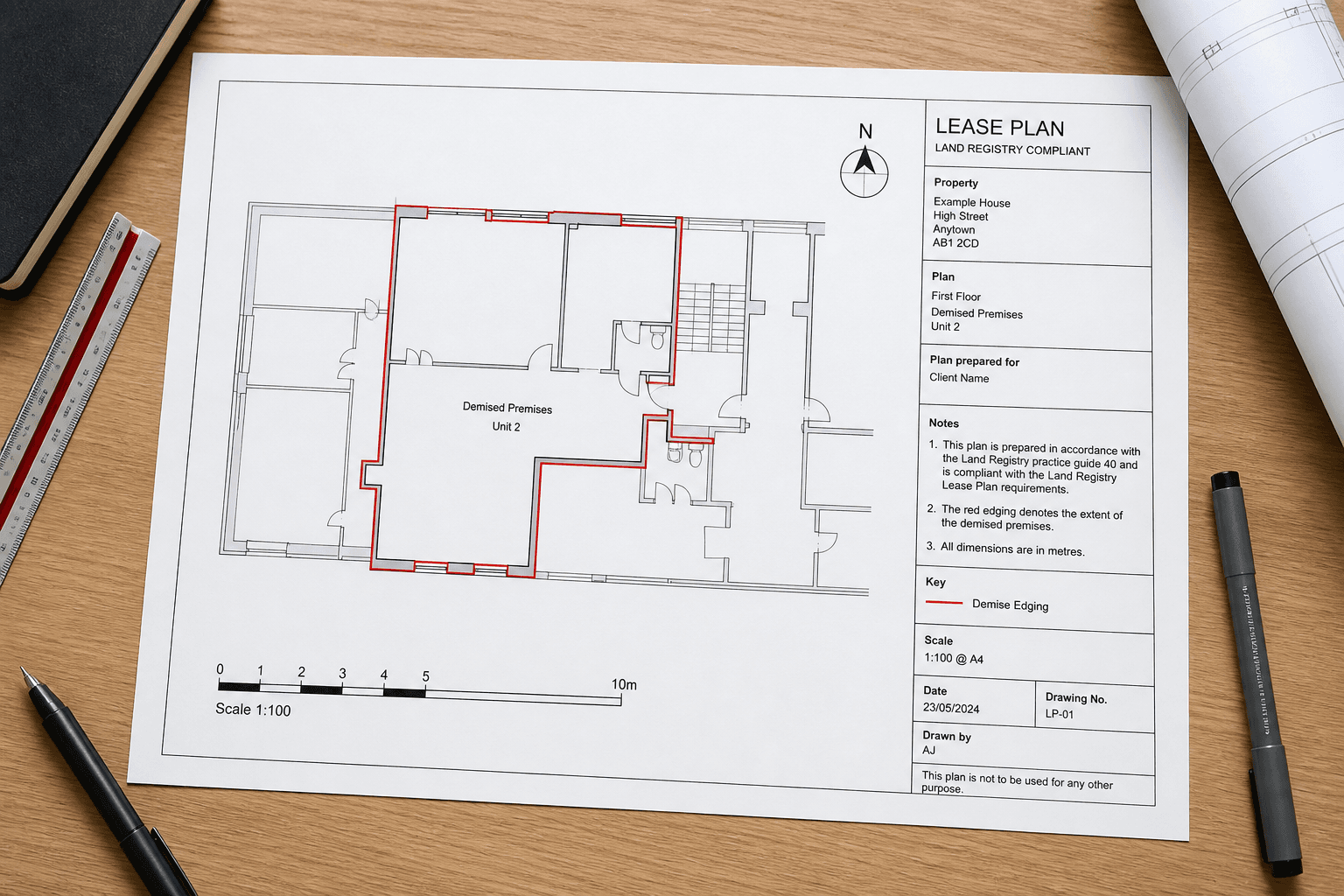
The Land Registry's requirements are specific. A compliant lease plan must:
- Be drawn to a stated metric scale (conventionally 1:100 or 1:200 for floor layouts)
- Include a north point
- Show the property's full postal address
- Identify the demised premises clearly, conventionally edged in red
- Show land retained by the landlord where relevant (conventionally edged in blue)
- Show the property in relation to surrounding roads or land so it can be located on the Ordnance Survey map
- Include measurements that match the scale — "do not scale" disclaimers are not accepted
Plans also need to deal with the details that catch people out: flats demised on multiple floors need each floor shown, external areas such as bins, sheds and parking must be identified, and airspace or subsoil exclusions should be clear. Our guide to Land Registry lease plan requirements covers the full checklist.
What Happens If the Plan Is Rejected
The Land Registry raises a requisition — a formal request to fix the defect. The application is put on hold, the solicitor has to obtain a corrected plan, and in the meantime the transaction sits in limbo. If the requisition is not answered in time, the application can be cancelled entirely, losing its priority.
For a leaseholder mid-sale, that can mean weeks of delay for the sake of a document that takes days to produce properly.
Lease Plan vs Floor Plan: Don't Mix Them Up
It is tempting to send the estate agent's floor plan to the solicitor and hope for the best. It almost never works — marketing plans are not to scale, lack a north point and do not identify the demise. The differences are covered in detail in our comparison of lease plans vs floor plans.
The good news: if you are marketing and selling at the same time, a specialist can measure once and produce both documents from the same site visit.
Getting a Compliant Plan Produced
Photoplan has produced lease plans for London flats, converted houses and commercial premises for over two decades. A surveyor measures on site, the plan is drawn to Land Registry standards, and most straightforward properties are turned around within a few working days.
If a transaction is already underway — or a requisition has landed — get in touch and we can usually prioritise the survey.
Just Need a Copy of an Existing Document?
Not every situation calls for a newly drawn plan. If you only need to check what is already registered — the current title plan, or the title register showing ownership, rights and charges — you can order copies of the official documents through our sister service.

Do you need a copy of an existing Land Registry document?
If you are looking for an existing Title Register or Title Plan rather than a newly prepared professional plan, our dedicated document retrieval service, Land Registry Docs, can help — copies of the official documents for any registered property or piece of land in England and Wales.
- Title Registers, Title Plans, or both as a bundle — from £24.95
- Every address checked by a person before retrieval
- Secure PDF delivery, usually within 1–2 hours during office hours
- Property Document Vault: 12 months' secure storage included free
Frequently Asked Questions

The Photoplan Team
Property Media Specialists
The Photoplan team produces property photography, floor plans, tours, video and CGI that help estate agents, developers and commercial clients market property beautifully.
Need a Land Registry compliant lease plan?
Photoplan produces accurate, compliant lease plans for flats, houses and commercial premises across London and the UK — measured on site and drawn to Land Registry standards, usually within days.
Estate agents book through the app · One-off customers order in the shop · or contact us
Related Articles
Land Registry Compliant Lease Plans Cost: What Affects the Price
Searching for land registry compliant plans cost? Here is what drives lease plan pricing in the UK — complexity, speed and why the cheap option often becomes the expensive delay.

When to Update Listing Photos (And When to Leave Them Alone)
Not every quiet week needs a reshoot. Here is a clear policy agents can use for when listing photography should be updated through the marketing life cycle.

Property Video Shot List for Estate Agents: What to Capture on Site
A useful property video is built from a disciplined shot list — not random walking footage. Here is what agents should ask for on the day.