
Lease Plans vs Floor Plans — What's the Difference?
Marketing floor plans and legally compliant lease plans look similar but serve very different purposes. This guide explains the key differences — including accuracy, scale, orientation and when each type is needed.
Key Takeaways
- Floor plans for marketing show layout and indicative room sizes; they are not legally precise documents.
- Lease plans must meet Land Registry requirements for scale, north point, boundary demarcation and floor identification.
- A marketing floor plan is not an acceptable substitute for a lease plan in a conveyancing transaction.
- Both types of plan can usually be produced in a single Photoplan survey visit.
- Accuracy standards differ significantly — a lease plan is measured to a higher tolerance than a typical marketing plan.
- Always confirm specific legal requirements with your solicitor or by consulting Land Registry guidance.
Floor plans and lease plans — the two terms are often used interchangeably, but they refer to very different documents with different purposes, different accuracy requirements and different consequences if the wrong one is used. Whether you are marketing a property for sale or navigating a conveyancing transaction, knowing which type you need — and why — can save significant time and cost.
Need accurate floor plans? Book a Photoplan floor plan service.
Photoplan surveys properties nationwide and delivers accurate measured floor plans and Land Registry-compliant lease plans — often combined with property photography in a single visit.
What is a marketing floor plan?
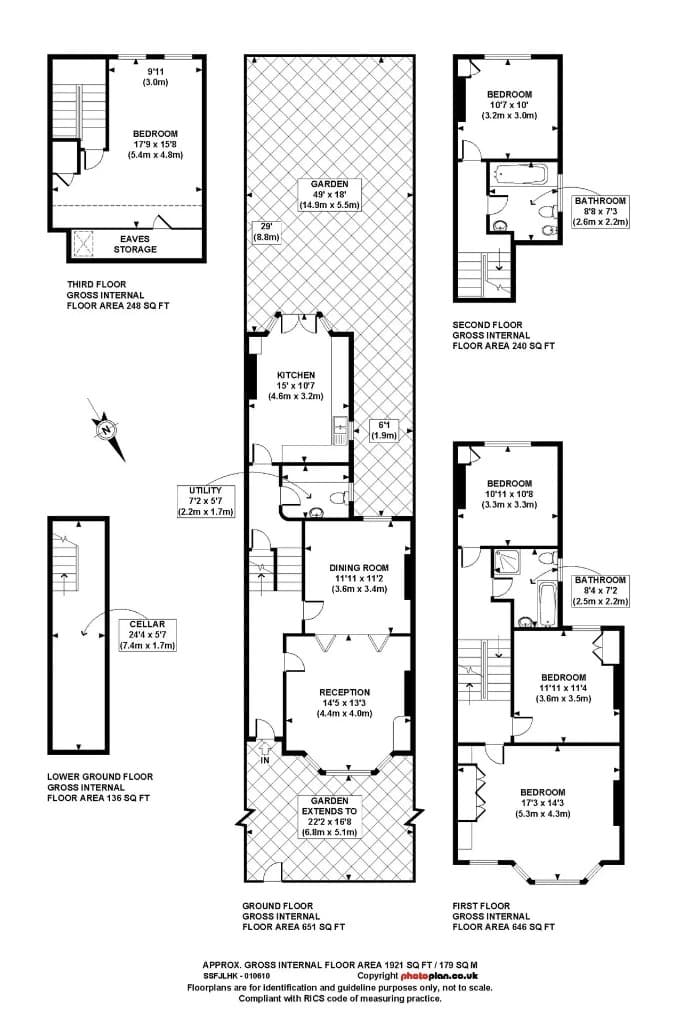
A marketing floor plan is a diagram that shows the layout of a property — room positions, approximate dimensions, and the relationship between spaces. Its primary purpose is to help prospective buyers or tenants understand the flow and scale of a home or commercial unit before they visit in person.
For estate agents, floor plans are an essential part of a property listing. Research consistently shows that properties marketed with floor plans attract more interest and convert enquiries at a higher rate. A good floor plan answers the question buyers ask before they book a viewing: does this property actually work for us?
What a marketing floor plan typically includes
- Room names and approximate dimensions
- Overall gross internal or net internal area (in square metres and/or square feet)
- Windows, doors and staircases to indicate natural light and flow
- An indication of scale — though not necessarily to a rigorous measured standard
- Sometimes an optional location context or site plan for new builds
Marketing floor plans prioritise clarity and readability at the expense of legal precision. They are produced to be understood at a glance on a screen or printed particulars, not scrutinised by a solicitor or Land Registry examiner.
What is a lease plan?
A lease plan is a measured drawing produced for a legal purpose — typically to accompany a lease or licence agreement and to be lodged with Land Registry as part of a property registration. It defines the legal extent of the demised premises: exactly what the tenant is taking on, where their space starts and ends, and how it relates to the wider building or site.
A lease plan is not a marketing document. Its audience is solicitors, conveyancers and Land Registry examiners. Its purpose is legal precision, not visual appeal.
For a detailed breakdown of what a lease plan must include, see our companion guide: What is a Lease Plan?
Key differences: lease plans vs floor plans
1. Purpose
| Marketing Floor Plan | Lease Plan | |
|---|---|---|
| Purpose | Help buyers understand layout | Define legal extent of a lease |
| Audience | Buyers, tenants, agents | Solicitors, Land Registry, landlords |
| Legal standing | None | Required for registration |
2. Accuracy and measurement
Marketing floor plans are produced to be indicative. Dimensions may be rounded to the nearest 0.1m and slight inconsistencies are acceptable — a buyer needs to know a bedroom is "around 3.5m × 3.2m", not whether it is 3.47m or 3.53m.
Lease plans must be sufficiently accurate for the extent of the property to be identified on the ground. Land Registry may reject a plan if dimensions are vague, if the demise is unclear, or if the plan does not correspond to what exists at the property. Accuracy here is not just about precision — it is about clarity of the legal boundary.
3. Scale
Marketing floor plans may use any convenient scale and often include a scale bar for reference but do not state a formal scale ratio. Lease plans must be drawn to a stated scale — commonly 1:100 or 1:50 for residential properties — with a scale bar or representative fraction clearly marked on the drawing.
4. Orientation
A north point is not required on a marketing floor plan, though better-produced ones often include it. For a lease plan, a north point (or north indicator) is a standard requirement so that the orientation of the property on the ground can be established from the plan.
5. Boundary demarcation and red edging
Marketing floor plans show internal wall lines. They do not typically show boundaries or indicate what is and is not included within the area being conveyed.
Lease plans must clearly show the extent of the demised premises. Red edging — outlining the boundary of the leased area in red — is the standard convention used to make this clear on Land Registry applications. For more detail on this and other Land Registry requirements, see our guide to Land Registry Lease Plan Requirements.
6. Floor level identification
In a multi-storey building, a marketing floor plan may simply show "Ground Floor" or "Apartment 3" as a label. A lease plan must clearly identify the floor or level to which the plan relates so that the extent of the demise can be established without ambiguity.
7. Location plan
For many lease registrations, a location plan showing the property in the context of the surrounding street or site is required alongside the floor plan. This allows Land Registry to locate the building on a map. Marketing floor plans do not include location plans.
When do you need each type?
You need a marketing floor plan when:
- Listing a property for sale or to let
- Creating digital or printed property particulars
- Presenting a development project to buyers or investors
- Showing layout to prospective commercial tenants
You need a lease plan when:
- Granting or registering a new lease of more than 7 years
- Extending a lease under the Leasehold Reform Act
- Buying or selling a leasehold property where registration is required
- Entering a commercial lease and the landlord or lender requires a registered title
- Any transaction where a solicitor requests a Land Registry-compliant plan
If you are unsure whether your transaction requires a lease plan rather than — or in addition to — a marketing floor plan, your solicitor is the right person to confirm this. Land Registry guidance is also available on the GOV.UK website.
Common mistakes to avoid
Submitting a marketing floor plan as a lease plan
This is the most frequent error. A plan produced for property marketing does not meet Land Registry standards. Scale, north point, red edging and floor identification may all be missing. The result is a requisition — a formal request for a compliant replacement plan — which delays the transaction.
Ordering the wrong type of survey
If your solicitor needs a lease plan, ordering a "floor plan" without specifying that it must be Land Registry-compliant may result in you receiving a marketing drawing. Always tell your surveyor the intended use before they attend.
Assuming a historic plan is still usable
Lease plans produced years ago may no longer accurately reflect the current configuration of a property, particularly after alterations. An outdated plan can cause problems at Land Registry if it does not match the property as it currently exists.
Relying on plans supplied by the landlord or developer
Plans provided by a freeholder or developer as part of a new build pack are sometimes marketing drawings, not Land Registry-compliant lease plans. Check with your solicitor before relying on these.
How Photoplan produces both types
Photoplan surveyors carry out a full measured survey of the property — taking precise room-by-room measurements using professional laser equipment. The same survey data is then used to produce:
- A marketing floor plan formatted for estate agent particulars, with branded layout and area calculations
- A Land Registry-compliant lease plan drawn to the correct scale, with north point, red edging, floor level annotation and location plan where required
Both products can usually be delivered from a single visit, which is more efficient and cost-effective than commissioning two separate surveys from different providers.
Photoplan covers the whole of the UK and offers fast turnaround — typically 1–2 working days for standard plans. Floor plans are frequently combined with property photography in a single appointment.
Summary
Marketing floor plans and lease plans may look alike, but the distinction matters. A floor plan sells a property; a lease plan legally defines it. Getting this wrong — particularly in a conveyancing transaction — can cause delays, requisitions and additional cost.
If you need one type, the other, or both, Photoplan's floor plan and lease plan service covers all requirements from a single survey visit. Explore our other guides for more detail:
Always confirm legal requirements for your specific transaction with your solicitor or conveyancer. This guide is for general information only and does not constitute legal advice.
Need accurate floor plans? Book a Photoplan floor plan service.
Photoplan surveys properties nationwide and delivers accurate measured floor plans and Land Registry-compliant lease plans — often combined with property photography in a single visit.
Frequently Asked Questions

The Photoplan Team
Property Media Specialists
The Photoplan team produces property photography, floor plans, tours, video and CGI that help estate agents, developers and commercial clients market property beautifully.
Need accurate floor plans? Book a Photoplan floor plan service.
Photoplan surveys properties nationwide and delivers accurate measured floor plans and Land Registry-compliant lease plans — often combined with property photography in a single visit.
Estate agents book through the app · One-off customers order in the shop · or contact us
Related Articles

AI Image Enhancement Explained — HDR Photo, PhotoEdit and PhotoClear
HDR Photo, PhotoEdit and PhotoClear are three AI-powered image enhancement tools in the ReHub Studio suite. This guide explains what each one does, when to use it, how it improves listing photography, and how the three tools work together as a connected workflow for estate agents and property photographers.

The Complete AI Property Marketing Guide — From Photoshoot to Portal
Estate agents now have access to a connected AI workflow that takes a property from photoshoot through to portal-ready listing assets in a single pipeline. This guide explains each stage — photo, declutter, stage, edit, video, twilight — and how ReHub Studio connects them.

AI Property Videos Explained — How They Work and When to Use Them
AI property videos turn listing photographs into short cinematic walkthrough videos without any filming. This guide explains how the technology works, how ImageMotion compares to a traditional videographer, what portals and social media platforms support property video, and when each approach is the right choice.