
Land Registry Lease Plan Requirements — Plain-English Guide
Land Registry sets out specific requirements for lease plans submitted with registration applications. This plain-English guide explains scale, north point, red edging, floor levels, location plans and what "sufficient detail" actually means in practice.
Key Takeaways
- Lease plans must be drawn to a clearly stated scale — 1:100 is typical for residential properties.
- A north point is required to establish orientation on the ground.
- The demised premises must be clearly shown, usually with red edging.
- Floor level must be identified on plans for flats and multi-storey buildings.
- A location plan is required to place the property in its street context.
- Land Registry may requisition any plan that lacks sufficient clarity or accuracy.
When a lease is registered at Land Registry, the plan submitted with the application must meet a defined standard. Plans that fall short are returned with a requisition — a formal request for a compliant replacement — and the registration is paused until the issue is resolved. Understanding what Land Registry actually requires, in practical terms, helps solicitors, leaseholders and landlords commission the right plan from the outset and avoid delays that can hold up a transaction.
Need accurate floor plans? Book a Photoplan floor plan service.
Photoplan surveys properties nationwide and delivers accurate measured floor plans and Land Registry-compliant lease plans — often combined with property photography in a single visit.
Why Land Registry sets requirements for lease plans
The land registration system in England and Wales depends on the accuracy and clarity of the documents held on title. A lease plan forms part of the permanent title record — it defines the legal extent of a leasehold interest for as long as that title exists, potentially for decades.
If a lease plan is ambiguous, inaccurate or missing key information, it creates risk. Future owners of the flat, solicitors dealing with later transactions and Land Registry examiners all rely on that plan to understand exactly what is owned and where. A poor plan can lead to disputes over boundaries, difficulties selling or mortgaging the property, and complications at renewal or extension.
The requirements Land Registry sets exist to ensure that every registered lease can be understood and relied upon without going back to the building itself.
The key requirements
1. Scale
The plan must be drawn to a stated scale. This does not mean it simply has a scale bar printed on it — it means the drawing has actually been produced at that scale and the stated scale accurately reflects the dimensions shown.
Typical scales:
- 1:100 — standard for most residential flats and small commercial units
- 1:200 — used for larger commercial premises or where a 1:100 plan would be unwieldy
- 1:50 — occasionally used for very small or complex spaces where more detail is needed
The scale must be stated on the plan as a ratio (e.g. 1:100) or as a scale bar that allows measurements to be checked. A plan without a stated scale is not compliant and will be requisitioned.
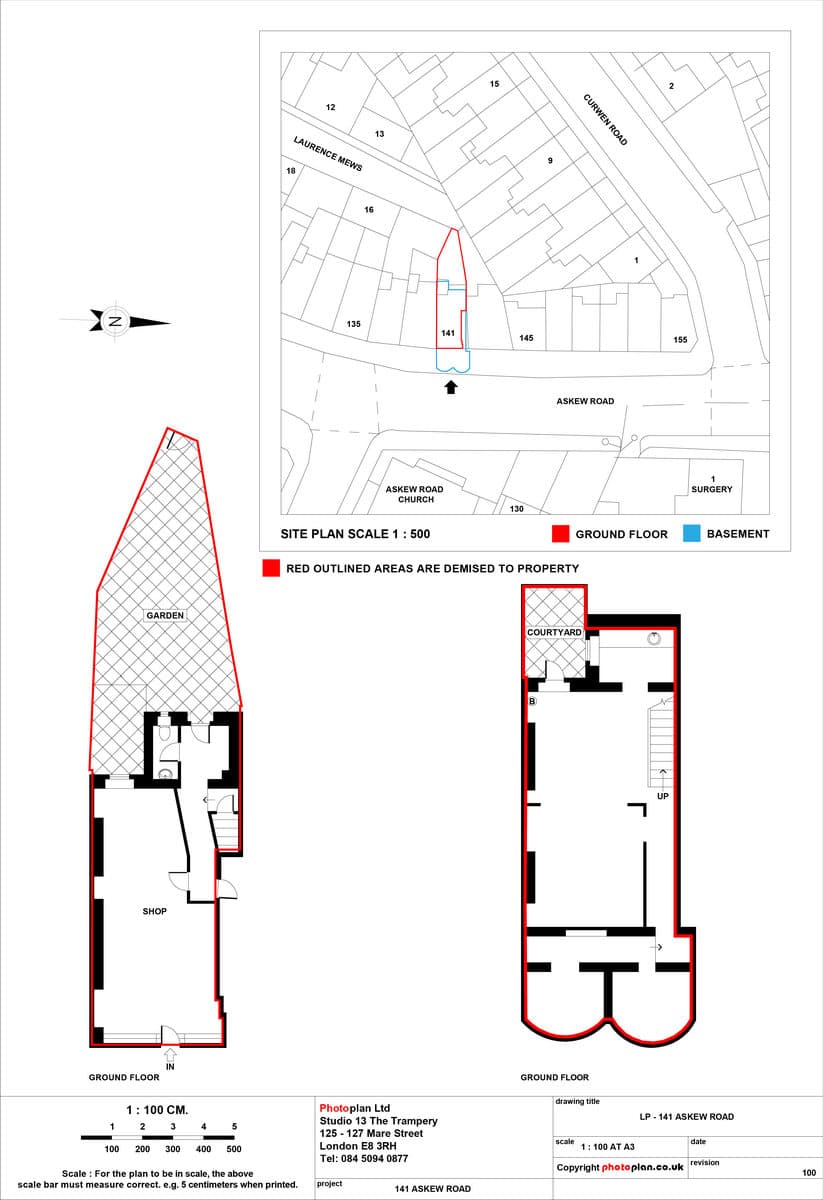
Plans drawn at too small a scale — for example 1:500 — may not show the demise with sufficient detail for the extent to be clearly identified.
2. North point
A north point (or north indicator) shows the orientation of the plan relative to compass north. It is required on every lease plan.
The reason is practical: Land Registry examiners and solicitors need to be able to relate the plan to the physical building as it stands on the ground and as it appears on mapping. Without a north point, it is impossible to establish orientation with certainty from the plan alone.
The north point does not need to be elaborate — a simple arrow labelled "N" is sufficient. What matters is that it is present and accurate.
3. The demise — shown with sufficient clarity
The most important element of a lease plan is the clear identification of the demised premises — the area being leased.
Red edging
The standard convention is to show the demise with a red edging: a continuous red line drawn around the external boundary of the leased area. Red edging is not a rigid legal requirement in all cases, but it is the method Land Registry expects and the one most likely to be accepted without question.
The red edging should enclose exactly the area being leased — no more and no less. For a residential flat, this typically means the internal faces of the perimeter walls (or the centre line of shared walls, depending on what the lease says). For a commercial unit, it may include the structural shell, a courtyard or a loading bay.
Common parts and shared rights
Where a tenant has rights over areas they share with others — a common corridor, a shared car park, an external path — these are sometimes shown in a different colour. Blue is a common convention for shared rights. The distinction between exclusive demise (red) and shared areas (blue or other colour) should be clear from the plan or an accompanying key.
Internal layout
The plan should show enough of the internal structure — partition walls, doors, stairwells, window positions — that the demise can be identified on the ground. A plain rectangle with red edging is unlikely to be sufficient for most properties.
4. Floor level identification
For any property that is part of a multi-storey building, the plan must clearly identify which floor it relates to. A flat described simply as "the premises" without identifying whether it is on the ground, first or second floor creates ambiguity that Land Registry cannot accept.
Floor level identification should appear as a clear label on the plan. For example: "Ground Floor", "First Floor", "Second Floor and Third Floor" (for a maisonette).
Where a demise extends across more than one floor — such as a duplex apartment or a commercial unit with a mezzanine — either:
- Separate plans should be provided for each floor, or
- A single plan with clear annotation showing the relationship between floors
5. Location plan
A location plan is a smaller-scale plan — typically 1:1250 or similar — that shows the property in its street context. Its purpose is to allow Land Registry to locate the building on mapping without ambiguity.
For most lease registration applications, a location plan is required in addition to the floor plan of the demise. Edging on the location plan (usually red) indicates which building or plot the registered title relates to.
The location plan does not need to be an Ordnance Survey extract — it can be any clear mapping base at an appropriate scale — but it must be sufficiently detailed to identify the building from street context.
6. Sufficient detail — what does this actually mean?
"Sufficient detail" is the standard Land Registry applies to the overall quality of a plan. It is not a precise checklist but a judgement about whether the plan, taken as a whole, allows the extent of the demised premises to be identified on the ground with reasonable certainty.
In practice, this means:
- The drawing corresponds to the physical reality of the building
- The dimensions shown are accurate enough to match the property
- Structural features — walls, windows, doors, stairs — are shown in their correct positions and proportions
- The boundary of the demise is drawn in the right place, not approximately
A plan that is roughly right may still be rejected if the discrepancy is significant enough that a future examiner might question whether the plan accurately reflects the title.
When are multiple plans required?
Multi-storey properties
As noted above, where a demise extends across more than one floor, multiple plans or a clearly annotated single plan are required.
Long leases of part of a building
Where an application involves a long lease of part of a building — for example one flat in a block — both a floor plan (showing the flat on its floor) and a location plan (showing the building in the street) are typically required.
Commercial schemes with external areas
Where a commercial lease includes external car parking, service areas or outbuildings, additional plans may be needed to show those elements clearly at an appropriate scale.
What happens when a lease plan is requisitioned?
A requisition is Land Registry's way of pausing a registration to request additional information or a corrected document. Requisitions are issued when:
- A plan is missing required elements (north point, scale, floor level, etc.)
- The demise is not clearly shown or is ambiguous
- The plan does not match the title already on register
- The plan is of insufficient quality to be reproduced reliably in the register
When a requisition is raised, the registration is placed on hold. The applicant (usually the solicitor) must respond with a compliant plan. This takes time, which in a live property transaction can mean delays to completion.
Commissioning a professionally measured plan — rather than attempting to adapt a marketing floor plan — significantly reduces the risk of a requisition.
Common mistakes that lead to requisitions
Missing north point — one of the most frequent omissions on plans that have been adapted from marketing drawings. It is easy to overlook and easy for Land Registry to spot.
Unstated or estimated scale — a plan printed with a scale bar that does not reflect the actual scale of the drawing. This can happen when a plan is resized during printing or file conversion.
Unclear boundary — the red edging does not match what the lease describes, or the boundary is drawn through the middle of a wall when the lease says it runs along the inside or outside face.
Wrong floor labelled — a plan that shows "First Floor" when the flat is actually on the second floor, due to an error in the surveyor's notes or the draughtsperson's annotation.
No location plan — submitted without the context plan that allows the building to be identified.
Out-of-date plan — a plan that does not reflect alterations made to the property since the original survey, meaning the plan no longer corresponds to the physical reality.
How Photoplan ensures compliance
Photoplan's surveyors carry out a full measured survey of every property, capturing precise dimensions using professional laser equipment. Lease plans are produced with all required elements:
- Stated scale (1:100 as standard, others on request)
- North point
- Red edging showing the demise
- Floor level identification
- Location plan where required
Plans are delivered digitally, formatted for direct use in conveyancing documentation. The same survey visit can simultaneously produce a marketing floor plan for estate agent use — both types of plan are generated from the same measured data.
If you are unsure whether an existing plan is compliant, or if a solicitor has raised concerns about a plan you already hold, contact Photoplan to discuss a re-survey.
Further reading
- What is a Lease Plan? — a broader introduction to lease plans and when they are needed
- Lease Plans vs Floor Plans — the key differences between marketing and legal plans
- Photoplan Lease Plan Service — book a survey
- All guides
For authoritative guidance, Land Registry publishes practice guides on its GOV.UK pages — including Practice Guide 40, which covers leasehold titles in detail.
This guide is for general information only. It does not constitute legal advice. Always confirm the requirements for your specific registration application with your solicitor or conveyancer, and check current Land Registry guidance directly for the most up-to-date requirements.
Need accurate floor plans? Book a Photoplan floor plan service.
Photoplan surveys properties nationwide and delivers accurate measured floor plans and Land Registry-compliant lease plans — often combined with property photography in a single visit.
Frequently Asked Questions

The Photoplan Team
Property Media Specialists
The Photoplan team produces property photography, floor plans, tours, video and CGI that help estate agents, developers and commercial clients market property beautifully.
Need accurate floor plans? Book a Photoplan floor plan service.
Photoplan surveys properties nationwide and delivers accurate measured floor plans and Land Registry-compliant lease plans — often combined with property photography in a single visit.
Estate agents book through the app · One-off customers order in the shop · or contact us
Related Articles

AI Image Enhancement Explained — HDR Photo, PhotoEdit and PhotoClear
HDR Photo, PhotoEdit and PhotoClear are three AI-powered image enhancement tools in the ReHub Studio suite. This guide explains what each one does, when to use it, how it improves listing photography, and how the three tools work together as a connected workflow for estate agents and property photographers.

The Complete AI Property Marketing Guide — From Photoshoot to Portal
Estate agents now have access to a connected AI workflow that takes a property from photoshoot through to portal-ready listing assets in a single pipeline. This guide explains each stage — photo, declutter, stage, edit, video, twilight — and how ReHub Studio connects them.

AI Property Videos Explained — How They Work and When to Use Them
AI property videos turn listing photographs into short cinematic walkthrough videos without any filming. This guide explains how the technology works, how ImageMotion compares to a traditional videographer, what portals and social media platforms support property video, and when each approach is the right choice.