
What is a Lease Plan?
A lease plan is a measured drawing that defines the legal extent of a leased property. This guide explains what a lease plan is, who needs one, what it must include, and when it is required for residential and commercial transactions.
Key Takeaways
- A lease plan defines the legal extent of the demised premises, not just the room layout.
- It is required for registering most new leases, lease extensions and assignments at Land Registry.
- A marketing floor plan is not a substitute — lease plans must meet specific accuracy and annotation standards.
- Residential leaseholders, commercial tenants, landlords and solicitors all rely on accurate lease plans.
- Photoplan produces Land Registry-compliant lease plans from a single measured survey visit.
- Confirm whether a lease plan is required for your specific transaction with your solicitor.
A lease plan is one of those documents that most people only encounter when they are buying, selling or extending a leasehold property — often at a point in a transaction when speed and accuracy matter most. Understanding what a lease plan is, why it exists and what makes one compliant can help avoid delays and make sure the right document is commissioned from the outset.
Need accurate floor plans? Book a Photoplan floor plan service.
Photoplan surveys properties nationwide and delivers accurate measured floor plans and Land Registry-compliant lease plans — often combined with property photography in a single visit.
The core purpose of a lease plan
A lease plan exists to answer one precise legal question: what, exactly, is the tenant taking on?
When a lease is granted, extended or registered, the legal documentation must make clear the physical extent of the premises being leased. Words alone are rarely sufficient — "the flat on the first floor" or "the shop unit to the left of the entrance" can be ambiguous, open to dispute and difficult to identify on the ground years later.
A lease plan provides a spatial definition of the demised premises: a scaled, measured drawing that shows the extent of the leasehold title in a way that is unambiguous to solicitors, Land Registry examiners and future owners of the property.
Who needs a lease plan?
Residential leaseholders
The majority of flats and apartments in England and Wales are sold on long leasehold titles. Every registered leasehold title requires a compliant lease plan showing the extent of the flat. This means:
- Flat buyers — a lease plan forms part of the title documentation registered at Land Registry when the flat is first sold on a long lease
- Lease extension applicants — when a leaseholder extends their lease (whether informally or under the Leasehold Reform Act), the extended lease requires a compliant plan
- Freehold conversion — when leaseholders collectively enfranchise and acquire the freehold, individual flat titles need accurate plans
Commercial tenants and landlords
Commercial leases — for offices, retail units, warehouses and industrial premises — routinely require lease plans, particularly where:
- The lease is for more than seven years and will be registered at Land Registry
- The premises form part of a larger building with shared areas and common parts
- The landlord or tenant's lender requires a registered title as security
Solicitors and conveyancers
Solicitors routinely request lease plans as part of the documentation bundle for any transaction involving a leasehold title. If a plan is missing, out of date or does not meet Land Registry standards, the solicitor may ask for a new one before they can proceed.
What a lease plan must include
A compliant lease plan is not simply a room layout diagram. It must provide enough information for the extent of the demised premises to be identified with certainty. The key elements are:
The demise — clearly shown
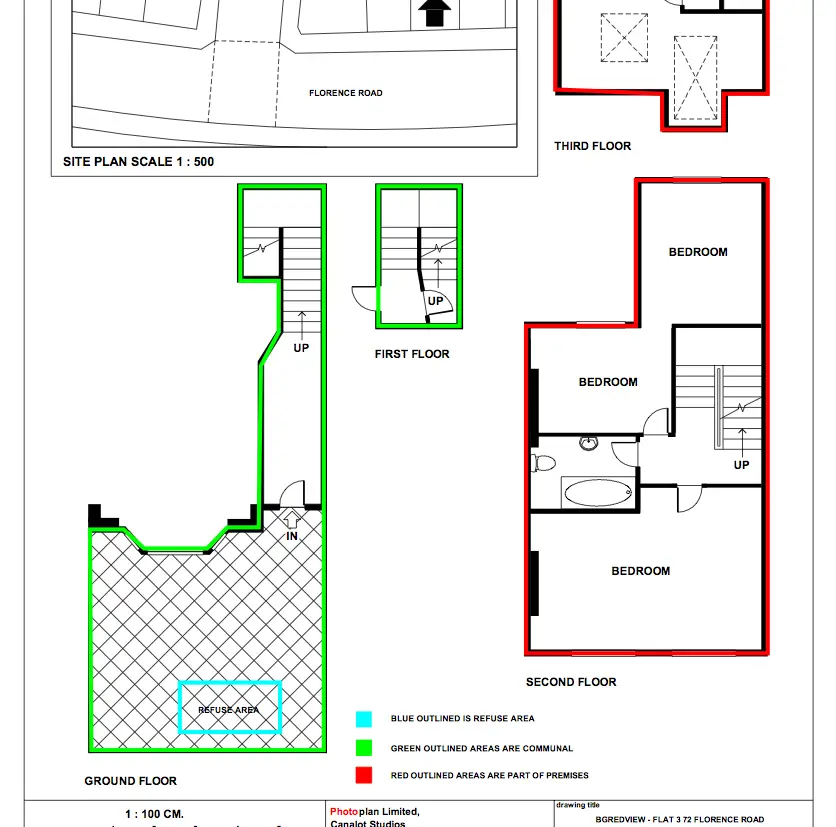
The area being leased must be clearly delineated. The standard convention is red edging — a red outline around the boundary of the leased premises. This distinguishes the demise from adjacent areas such as shared corridors, external walls or neighbouring units.
For a full breakdown of requirements, see our guide: Land Registry Lease Plan Requirements.
Scale
The plan must be drawn to a stated scale. For residential properties, 1:100 is the most common scale. For larger commercial premises, 1:200 may be appropriate. A scale bar or representative fraction (e.g. 1:100) must appear on the plan so that distances can be confirmed from the drawing.
North point
A north indicator or north point allows the orientation of the property to be established. This is particularly important where the extent of the demise includes external areas, gardens or parking.
Floor level identification
In a multi-storey building, it must be clear which floor the plan relates to. Where a demise extends over more than one floor — for example a maisonette or a duplex apartment — separate plans for each floor may be required, or the relationship between floors must be clearly indicated.
Location plan
Many lease registrations require a location plan — a smaller-scale plan showing the property in the context of the surrounding street layout, to allow Land Registry to locate the building. This is particularly important for registered titles where the property cannot be easily identified without street context.
Lease plans in residential transactions
New leases on purpose-built flats
When a developer sells new-build flats on long leases, the lease plan is typically produced by the developer's surveyor as part of the conveyancing documentation. Buyers' solicitors check that the plan meets Land Registry requirements before the title is registered.
Lease extensions
Lease extensions are one of the most common reasons an individual leaseholder needs to commission a lease plan. Whether the extension is agreed informally between leaseholder and freeholder, or is being pursued formally under the Leasehold Reform Housing and Urban Development Act 1993, the new or extended lease must be registered — and a compliant plan is required to do so.
In many cases, the existing lease already has a plan. If it meets current standards and accurately reflects the property as it exists today, it may be reusable. If the property has been altered, or if the original plan does not meet current requirements, a new survey will be needed.
Leasehold sales and assignments
When a leasehold flat is sold, the title — including the lease plan — transfers to the buyer. If the existing plan is out of date or inadequate, the buyer's solicitor may raise this as a requisition. Sellers are occasionally asked to commission a new plan before a transaction can complete.
Lease plans in commercial transactions
Commercial lease plans follow the same principles but often involve more complex premises. A commercial lease plan must show:
- The exact extent of the tenant's exclusive space
- Any areas the tenant has the right to use in common (marked in a different colour, often blue or green)
- External areas included in the demise, such as car parking, loading bays or external storage
- Rights of way across shared areas where relevant
For large or multi-level commercial premises, a set of plans — one per floor — may be required, sometimes accompanied by a site plan and a location plan.
How a lease plan is produced
A lease plan begins with a measured survey of the property. A surveyor attends the premises and takes precise measurements of every room, corridor and relevant space using professional laser measuring equipment.
From the survey data, the plan is drawn to the correct scale, annotated with the required information (north point, floor level, scale ratio, red edging) and formatted for submission to Land Registry alongside the lease.
Photoplan carries out lease plan surveys across the whole of the UK, with delivery typically within 1–2 working days of the survey appointment. The same visit can also produce a marketing floor plan for estate agent use, or be combined with property photography if the property is being simultaneously marketed.
Common questions about lease plans
Is a lease plan the same as a title plan?
No. A title plan is produced by Land Registry itself (formerly on Ordnance Survey mapping) and shows the general extent of a registered title. A lease plan is a privately commissioned measured drawing that accompanies the lease document. The two serve related but different purposes.
Can I draw my own lease plan?
Land Registry does not require a plan to be produced by a specific type of professional, but it must meet the requirements for accuracy, scale, annotation and clarity. In practice, a plan produced without professional surveying equipment is unlikely to meet the standard — and a rejected or requisitioned plan can delay a transaction significantly.
What happens if my lease plan is rejected?
If Land Registry raises a requisition against a lease plan — questioning its accuracy, clarity or compliance — the transaction is paused until a compliant replacement is provided. Commissioning a professional plan from the outset avoids this delay.
Where Photoplan fits
Photoplan provides Land Registry-compliant lease plans as a standalone service or as part of a combined floor plan and photography appointment. Our surveyors are experienced in producing plans that meet the requirements for residential and commercial lease registration — minimising the risk of requisitions and helping transactions proceed smoothly.
Book a lease plan survey or browse our related guides:
This guide is intended for general information only. It does not constitute legal advice. Always confirm the specific requirements for your transaction with your solicitor, conveyancer or by consulting Land Registry guidance directly.
Need accurate floor plans? Book a Photoplan floor plan service.
Photoplan surveys properties nationwide and delivers accurate measured floor plans and Land Registry-compliant lease plans — often combined with property photography in a single visit.
Frequently Asked Questions

The Photoplan Team
Property Media Specialists
The Photoplan team produces property photography, floor plans, tours, video and CGI that help estate agents, developers and commercial clients market property beautifully.
Need accurate floor plans? Book a Photoplan floor plan service.
Photoplan surveys properties nationwide and delivers accurate measured floor plans and Land Registry-compliant lease plans — often combined with property photography in a single visit.
Estate agents book through the app · One-off customers order in the shop · or contact us
Related Articles

AI Image Enhancement Explained — HDR Photo, PhotoEdit and PhotoClear
HDR Photo, PhotoEdit and PhotoClear are three AI-powered image enhancement tools in the ReHub Studio suite. This guide explains what each one does, when to use it, how it improves listing photography, and how the three tools work together as a connected workflow for estate agents and property photographers.

The Complete AI Property Marketing Guide — From Photoshoot to Portal
Estate agents now have access to a connected AI workflow that takes a property from photoshoot through to portal-ready listing assets in a single pipeline. This guide explains each stage — photo, declutter, stage, edit, video, twilight — and how ReHub Studio connects them.

AI Property Videos Explained — How They Work and When to Use Them
AI property videos turn listing photographs into short cinematic walkthrough videos without any filming. This guide explains how the technology works, how ImageMotion compares to a traditional videographer, what portals and social media platforms support property video, and when each approach is the right choice.