
How to Measure a House for a Floor Plan
A step-by-step guide to measuring a residential property correctly — covering room sketches, wall lengths, doors, windows, stairs, built-in cupboards, ceiling heights and how to spot errors before they reach a final drawing.
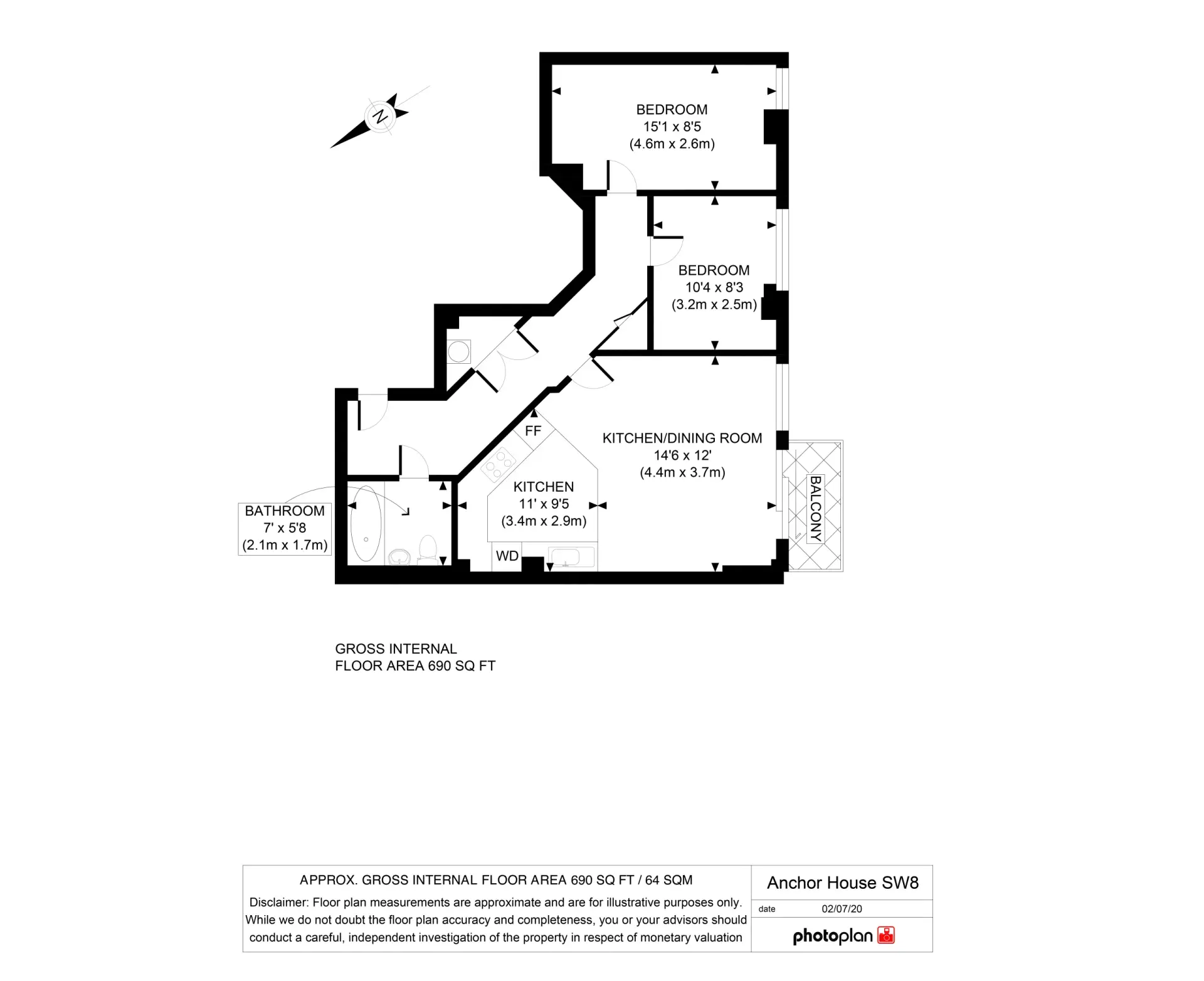
Key Takeaways
- Sketch the whole floor before you measure — knowing the shape prevents missed walls.
- Measure in a consistent direction (clockwise) to avoid duplicating or skipping elements.
- Record doors, windows, bay projections, alcoves and built-in cupboards separately to wall lengths.
- Note ceiling heights on every floor; they affect GIA calculations and lease plan compliance.
- Always cross-check by comparing opposing-wall totals — discrepancies flag measurement errors.
- For estate agency listings, lease plans or planning applications, use a professional floor plan service rather than DIY measurement.
Measuring a house for a floor plan sounds straightforward until you are standing in the middle of an L-shaped kitchen, unsure whether you have already recorded the alcove by the boiler. Getting it right requires a methodical approach — a clear sketching order, consistent measurement technique and a structured way to check your totals before you leave the property. This guide walks through the complete process, from the first pencil sketch to the final cross-check, and explains when it makes more sense to hand the job to a professional surveyor.
Need accurate floor plans? Book a Photoplan floor plan service.
Photoplan surveys properties nationwide and delivers accurate measured floor plans and Land Registry-compliant lease plans — often combined with property photography in a single visit.
Before You Start: Equipment and Preparation
The right tools make a significant difference to the quality of your measurements.
Essential equipment:
- Laser distance measure — a Leica Disto, Bosch GLM or equivalent. Far faster and more accurate than a steel tape over distances greater than two metres. See our guide to the best laser measures for floor plans for current recommendations.
- Clipboard and paper — pre-drawn grid paper helps keep rough sketches roughly to scale.
- Pencil (not pen — you will correct mistakes)
- Notepad for ceiling heights and notes on unusual features
- Smartphone or camera to photograph tricky junctions, roof slopes or unusual walls that are hard to sketch in the field
Walk through the entire property once before you measure anything. Identify how many floors there are, where the staircase runs, which rooms are open plan, and note any features that will complicate a drawing: bay windows, chimney breasts, sloping ceilings, dormer windows, large built-in wardrobes or external protrusions like porches and garages.
Step 1: Sketch the Floor Plate First
Before you take a single measurement, produce a rough freehand sketch of each floor. Do not worry about proportion — the sketch exists only to give you a framework in which to record numbers.
Work from the exterior if you can see the full building outline, or trace the internal perimeter from just inside the front door, moving clockwise. Note:
- Every change in wall direction
- Staircase location and approximate size
- Open doorways between rooms
- Bay window projections
- Any external walls that are not at 90° to each other
A sketch that misses a wall or a corridor leads to measurements that cannot be reconciled later. Five minutes of careful observation at this stage saves time correcting errors at the drawing stage.
Step 2: Measure Wall Lengths in a Consistent Direction
With your sketch ready, measure each room in a consistent, clockwise direction. Start from the same corner every time — ideally the corner nearest the entrance door — and work around the perimeter.
Measuring straight walls
Set your laser measure to continuous (sometimes labelled "tracking") mode and rest it flat against the wall surface. Record the reading to the nearest millimetre. Write the dimension directly onto your sketch beside the wall it belongs to.
For walls longer than the range of your laser, use the Pythagorean add-on function available on most modern measures, or set up a temporary reflector (a sheet of white card taped to a doorframe works well).
Measuring bay windows and projections
A bay window has three distinct measurements:
- The width of the bay opening in the main wall (the gap between the two side walls)
- The depth of the bay projection from the main wall face to the glazing
- The angled or straight return widths on each side
Measure all three and record them separately on your sketch. Do not guess or estimate.
Alcoves and chimney breasts
Chimney breasts and recessed alcoves should be measured as sub-elements within the wall run. Record:
- The width of the chimney breast or alcove (left-to-right across the room)
- The depth it projects into the room
- Its position relative to the nearest corner
These measurements matter because chimney breasts are often the primary cause of reconciliation errors in properties built before 1970.
Step 3: Record Door and Window Positions
Doors and windows are not usually shown as simple cut-outs — their position on a wall matters for the drawing, particularly for doors that might swing into an adjacent room or obstruct a hallway.
For each opening, record:
- Distance from the nearest corner to the edge of the door or window frame
- Width of the opening (frame-to-frame, not including architrave)
- Which way the door opens (note this on your sketch with a small arc)
For windows, note the sill height from floor level and the head height from floor level. These are used to produce elevations and are essential if the floor plan will be used in a planning application or building regulations submission.
Step 4: Measure the Staircase
Staircases are one of the most commonly simplified elements in amateur floor plans, and one of the most important to get right — particularly in maisonettes, townhouses and flats where the stair void affects both floor plates.
Measure:
- Overall run — the horizontal length of the staircase from the bottom newel to the top newel post
- Width — the clear width between the strings (or between wall and string for a staircase against a wall)
- Landing depth — the platform at the top and bottom, measured from the top riser to the opposite wall
If the stair turns (dog-leg or quarter-turn), measure each flight and landing as a separate element. Note which wall the handrail is on and whether there is a half-landing with a window.
Step 5: Record Built-In Cupboards and Fitted Furniture
Built-in wardrobes, utility cupboards, airing cupboards and fitted kitchen units all count toward the gross internal area of a property. They should appear in your floor plan.
For each built-in element, record:
- Its position along the wall (distance from nearest corner)
- Its overall width
- Its depth (front-to-back)
Do not measure into fitted kitchen units — their depth is typically shown diagrammatically (usually 600 mm for base units, 300 mm for wall units) rather than individually measured. However, unusual bespoke units should be measured properly.
Step 6: Note Ceiling Heights on Every Floor
Ceiling height affects gross internal area calculations under RICS standards — areas with a clear height below 1.5 m are typically excluded, and areas between 1.5 m and 2.1 m are often measured at half-value for certain calculation methods. Even if you are only producing a simple marketing floor plan, noting ceiling heights protects you from producing an area total that overstates usable space.
Measure:
- The ceiling height in the centre of each room (clear of any downlighters or coving)
- The head height at the top and bottom of each flight of stairs
- In rooms with sloped ceilings (loft conversions, attic rooms), the height at the highest point and the height where the ceiling meets the floor or knee-wall
Step 7: Cross-Check Your Totals Before You Leave
The single most important quality-control step in field measurement is cross-checking opposing wall totals.
In a rectangular room, the sum of all measurements taken along the north face should equal the sum taken along the south face (i.e. the wall directly opposite). In more complex shapes, the same principle applies: the sum of all east-facing wall segments must equal the sum of all west-facing segments.
If your totals disagree by more than 20 mm in a single room, retake the measurements that seem suspect before you pack up. A discrepancy you ignore in the field becomes a drawing error you cannot explain at the desk.
Common Mistakes to Avoid
Measuring to the skirting board rather than the wall face
Laser measures are typically fired at floor level, where a skirting board may add 12–20 mm of depth. For consistency, always aim at the face of the plaster above the skirting, or account for the skirting in your notation.
Missing the void above the stairwell on an upper floor
When you reach the upper floor, the stairwell creates an open void in the floor plate. This is not a room and should not be included in the area calculation. Sketch the void clearly and label it so the draughtsman does not close it in.
Ignoring sloping ceilings in loft conversions
A loft room with 2.4 m at the ridge and 0.9 m at the knee-wall has a much smaller usable area than its floor footprint suggests. RICS standards require you to measure only the area where the ceiling clears 1.5 m for exclusions (or 1.8 m for certain commercial uses). Always walk the slope and note the point where the ceiling drops below the relevant threshold.
Forgetting external features
Porches, utility overflows, integral garages, conservatories and outbuildings all need to be measured separately, clearly labelled, and excluded from — or noted as additions to — the main dwelling area depending on the required measurement standard.
When to Use a Professional Floor Plan Service
DIY measurement is appropriate for internal furniture planning or rough space assessment. For any of the following situations, a professional surveyor is strongly recommended:
- Estate agency marketing — floor plans submitted with property listings are expected to be accurate to within ±5% of total area. Errors can lead to complaints, vendor liability and portal compliance issues.
- Lease plans for Land Registry — these must meet specific RICS standards and be certified by a qualified surveyor. A hand-measured sketch will not be accepted.
- Planning applications and permitted development — plans submitted to local planning authorities must be precisely drawn and in some cases certified.
- Property disputes — if floor area is in contention between buyer and seller, an independently certified measured survey carries far more weight than an owner's own measurements.
Photoplan's floor plan service covers properties across the UK. Surveyors use calibrated laser equipment and professional CAD software to produce accurate, annotated floor plans typically delivered within 24 hours of the survey. Lease plans are produced to Land Registry specification and include all required annotations and certifications. Both services can be combined with property photography in a single visit to minimise disruption to vendors and tenants.
Further Reading
For related topics in this series, see:
- How accurate are floor plans? — understanding measurement tolerances and when you need a higher-standard survey
- RICS measuring standards explained — GIA, NIA, IPMS and which standard applies to your property type
- Measuring extensions correctly — how to handle extensions, outbuildings and complex footprints
Browse all our guides at /guides or explore our floor plan and lease plan services to book a professional survey.
Need accurate floor plans? Book a Photoplan floor plan service.
Photoplan surveys properties nationwide and delivers accurate measured floor plans and Land Registry-compliant lease plans — often combined with property photography in a single visit.
- #floor plans
- #how to measure a house
- #property measurement
- #estate agent floor plans
- #RICS measuring
Frequently Asked Questions

The Photoplan Team
Property Media Specialists
The Photoplan team produces property photography, floor plans, tours, video and CGI that help estate agents, developers and commercial clients market property beautifully.
Need accurate floor plans? Book a Photoplan floor plan service.
Photoplan surveys properties nationwide and delivers accurate measured floor plans and Land Registry-compliant lease plans — often combined with property photography in a single visit.
Estate agents book through the app · One-off customers order in the shop · or contact us
Related Articles

AI Image Enhancement Explained — HDR Photo, PhotoEdit and PhotoClear
HDR Photo, PhotoEdit and PhotoClear are three AI-powered image enhancement tools in the ReHub Studio suite. This guide explains what each one does, when to use it, how it improves listing photography, and how the three tools work together as a connected workflow for estate agents and property photographers.
The Complete AI Property Marketing Guide — From Photoshoot to Portal
Estate agents now have access to a connected AI workflow that takes a property from photoshoot through to portal-ready listing assets in a single pipeline. This guide explains each stage — photo, declutter, stage, edit, video, twilight — and how ReHub Studio connects them.
AI Property Videos Explained — How They Work and When to Use Them
AI property videos turn listing photographs into short cinematic walkthrough videos without any filming. This guide explains how the technology works, how ImageMotion compares to a traditional videographer, what portals and social media platforms support property video, and when each approach is the right choice.